

TL;DR:
- Effective event budgeting requires clear goals, detailed cost breakdowns, and ongoing real-time tracking.
- Building a contingency fund of at least 10% helps manage unexpected expenses.
- Using purpose-built planning tools improves accuracy, organization, and adaptability during the event process.
Event costs have a way of growing quietly until they explode. One overlooked vendor deposit, one last-minute décor upgrade, and suddenly you're thousands over budget with no clear path back. Whether you're coordinating a wedding, a corporate retreat, or a private celebration, the financial pressure is real and the margin for error is slim. The good news is that budget overruns are almost always preventable. This guide walks you through a practical, step-by-step approach to setting, tracking, and optimizing your event budget so you can make confident decisions from day one to the final invoice.
Table of Contents
- Define your event budget and goals
- Break down costs and gather requirements
- Track and adjust your budget in real time
- Review, verify, and optimize your decisions
- Why most event budget advice misses the real challenge
- Take your budgeting to the next level with purpose-built tools
- Frequently asked questions
Key Takeaways
| Point | Details |
|---|---|
| Set clear budget goals | Begin planning with defined limits and outcomes for every event. |
| Break down all expenses | Identify and categorize every cost to prevent surprises and missed items. |
| Track spending in real time | Use digital tools to monitor costs and adjust your budget as the event progresses. |
| Review and learn post-event | Analyze what worked and what didn’t to continually optimize future event budgets. |
| Use purpose-built software | Specialized event planning platforms make budgeting faster, easier, and less stressful. |
Define your event budget and goals
Before you book a single vendor or tour a single venue, you need a financial framework. This isn't just about picking a number and hoping for the best. It's about understanding what your event actually requires and what you're willing to spend to achieve it.
Start by clarifying three things: the event type, the expected guest count, and your top priorities. A 200-person wedding has a very different cost structure than a 40-person corporate dinner. Setting a budget before planning reduces overspending by giving every decision a financial anchor.
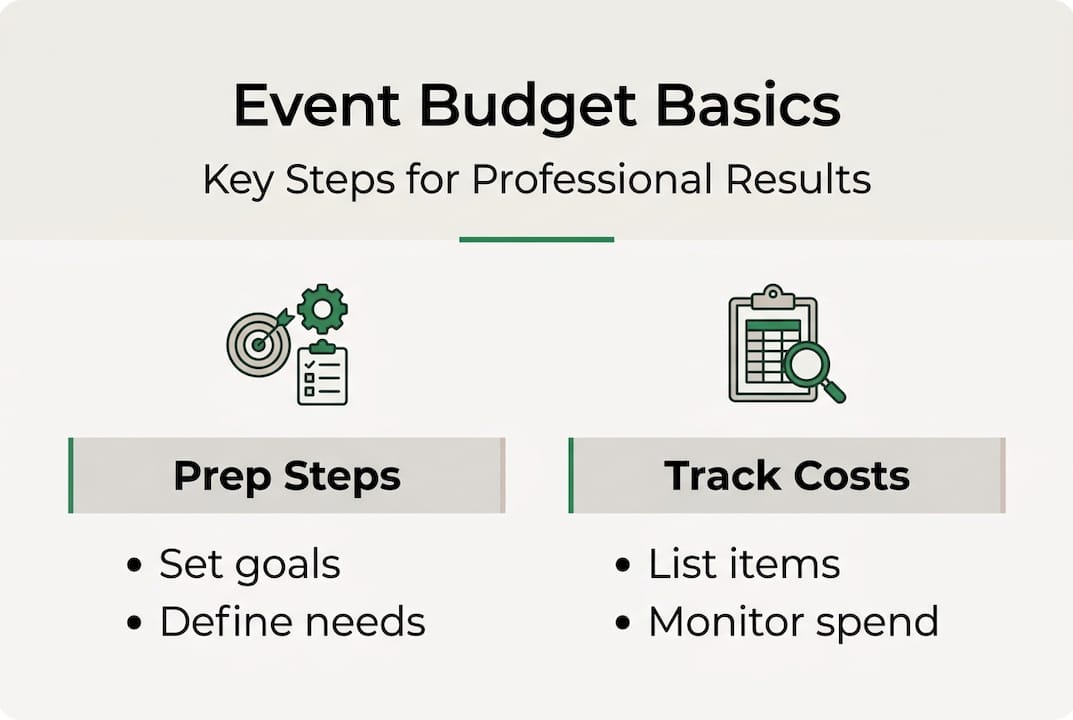
Research average costs for your event category before committing to anything. Here's a general allocation framework to get you started:
| Budget category | Typical % of total budget |
|---|---|
| Venue | 25-35% |
| Catering and beverages | 30-40% |
| Entertainment and music | 8-12% |
| Décor and florals | 8-10% |
| Photography and video | 8-12% |
| Logistics and staffing | 5-8% |
| Contingency fund | 10% |
These percentages shift depending on your priorities. If live entertainment is central to your event, you may pull from décor. If the venue is all-inclusive, catering costs may be bundled in.
Here's what to lock in during this phase:
- Event type and purpose (celebration, conference, milestone)
- Estimated guest count and whether it might grow
- Non-negotiable priorities (the things that define the event)
- Budget ceiling (the absolute maximum you can spend)
- Preferred vendor categories and rough cost expectations
Using an event budget tracker at this stage helps you assign dollar amounts to each category before spending begins, which keeps decisions grounded in reality rather than enthusiasm.
Pro Tip: Separate your must-haves from your nice-to-haves before you talk to a single vendor. When a salesperson shows you an upgrade, you'll know immediately whether it fits your priorities or just sounds appealing.
Break down costs and gather requirements
With your goals and budget set, the next step is to get specific about each expense. Vague line items like "food and drinks" are where budgets go to die. You need to know exactly what you're paying for and why.
Every event has cost centers that are easy to overlook until the invoice arrives. Detailed breakdowns help prevent missed expenses, especially for variable costs like overtime charges, service fees, and gratuities.
Here's how typical expenses compare across event types:
| Expense category | Wedding | Corporate event | Private party |
|---|---|---|---|
| Venue rental | $3,000-$15,000 | $1,500-$8,000 | $500-$5,000 |
| Catering per person | $75-$250 | $40-$120 | $30-$100 |
| Entertainment | $1,500-$5,000 | $500-$3,000 | $300-$2,000 |
| Décor and florals | $2,000-$8,000 | $500-$2,000 | $200-$1,500 |
| Photography | $2,500-$6,000 | $800-$3,000 | $400-$1,500 |
These ranges give you a realistic starting point for negotiations. Now, here's the step-by-step process to collect what you need:
- List every possible cost category before contacting vendors. Use an event cost checklist to make sure nothing slips through.
- Contact at least three vendors per category to get competitive quotes. One quote is not a market rate.
- Request itemized proposals from every vendor, not summary totals. Line-by-line pricing reveals hidden fees.
- Clarify what's included and excluded in each quote, especially for catering and venue packages.
- Confirm payment schedules and deposit requirements so cash flow doesn't become a crisis.
- Use vendor coordinator tools to store proposals, compare options, and track communications in one place.
Pro Tip: Always ask vendors for itemized proposals. A flat quote of $5,000 for catering tells you nothing. An itemized proposal shows you exactly where the money goes and where there's room to negotiate.
Track and adjust your budget in real time
After identifying expenses, successful budget management requires active oversight. A budget that isn't updated as invoices arrive is just a wish list.

Real-time tracking prevents costly last-minute surprises by keeping your actual spending visible at every stage of planning. The moment a deposit clears, it should be logged. The moment a vendor sends a revised quote, your budget should reflect it.
Here are the best practices for keeping your budget current:
- Log every payment immediately after it's made, not at the end of the month
- Save all contracts and receipts in a centralized location linked to your budget
- Set payment deadline reminders so you never miss a due date or incur a late fee
- Track committed costs separately from paid costs so you know your true financial exposure
- Review your budget weekly during the active planning phase, not just at milestones
- Use a live budget tracking tool that updates totals automatically as you add expenses
Here's a number worth taking seriously: studies show that roughly 40% of events end up exceeding their original budget by 15% or more, often due to scope creep and untracked small expenses. That's not a rounding error. That's a significant financial hit that could have been avoided with consistent tracking.
Contingency planning is not optional. It's the single most underused tool in event budgeting. Build a contingency line into your budget from day one, separate from your other categories. If a vendor cancels, if weather forces a venue change, or if guest count jumps unexpectedly, you'll have a financial cushion rather than a crisis.
Use vendor tracking tools to monitor contract terms and payment timelines across all your suppliers. Knowing when each payment is due prevents cash flow surprises.
Pro Tip: Build in a contingency line of at least 10% of your total budget. If you don't need it, great. If you do, it's the difference between a stressful scramble and a calm solution.
Review, verify, and optimize your decisions
What happens after your event is just as important for future planning. Most planners close the books and move on. The best planners treat every completed event as a data set.
Post-event budget reconciliation is a structured process, not just a glance at your final invoice. Here's how to do it properly:
- Collect all final invoices and compare them to your original quotes. Note every discrepancy.
- Categorize every expense and total each budget line against what you planned to spend.
- Identify which categories ran over and determine why. Was it scope creep, poor estimates, or vendor changes?
- Calculate your total variance as a percentage of your original budget.
- Document lessons learned with specific notes on what to do differently next time.
Once you've reconciled, shift to evaluating value. Not every dollar spent delivers equal impact. Ask yourself:
- Which vendors delivered exceptional value relative to their cost?
- Which expenses had little visible impact on the guest experience?
- Where did you overspend on something guests didn't notice or care about?
- Which vendor relationships are worth investing in for future events?
Managing your guest list management data alongside budget records helps you see how headcount changes affected per-person costs, which is invaluable for future pricing.
"Events that undergo structured post-event budget reviews consistently show 12-18% cost savings in subsequent planning cycles, simply by eliminating repeat mistakes and renegotiating vendor terms with better data." Post-event reviews lead to smarter planning in every future event you coordinate.
The goal isn't perfection on the first try. It's continuous improvement. Each event you plan gives you better data, sharper instincts, and stronger vendor relationships.
Why most event budget advice misses the real challenge
Most budgeting guides hand you a spreadsheet template and call it a day. That's not wrong, but it's incomplete. The real challenge in event budgeting isn't building the initial framework. It's adapting when reality changes.
Priorities shift mid-planning. A corporate client upgrades their keynote speaker. A bride decides the floral arch is now essential. A venue becomes unavailable six weeks out. Rigid budgets crack under this kind of pressure because they were built for a plan that no longer exists.
True budget mastery is about maintaining financial clarity while staying flexible. That means documenting every decision and the reason behind it. When you move money from one category to another, write down why. When you approve a vendor upgrade, note what you cut to make room. This transparency protects you when stakeholders question costs later.
Budget tracking strategies built into digital tools make this kind of real-time adaptation practical rather than overwhelming. You can see the full picture instantly and make informed trade-offs instead of guessing.
The planners who consistently stay on budget aren't the ones with the most rigid spreadsheets. They're the ones who treat their budget as a living document and update it every time reality changes.
Take your budgeting to the next level with purpose-built tools
If you want to make budgeting efficient and stress-free, consider modern tools designed for event planners.
WdPlan brings together everything you need in one place. The budget tracker features automatically update your totals as you log expenses, so you always know exactly where you stand. The event checklist features help you capture every cost category before planning begins, eliminating the missed expenses that quietly blow budgets. From vendor coordination to guest management, the platform keeps your entire planning process organized and visible. If you're ready to stop managing budgets in disconnected spreadsheets, explore what event planning software built specifically for hosts and planners can do for your next event.
Frequently asked questions
What is the most common mistake in event budgeting?
Most planners overlook small, variable expenses like gratuities, overtime, and last-minute supplies, which cause significant overruns. Using a detailed event cost checklist from the start helps catch these before they add up.
How much contingency should I set aside for unexpected event costs?
A contingency fund of at least 10% of your total event budget is recommended to cover surprises or price changes. This buffer, supported by real-time tracking, keeps you in control when the unexpected happens.
What are the best tools for tracking event budgets?
Specialized event planning software with real-time budget tracking and expense recording features are the most effective options available to planners today.
How early should the event budget be established?
Set your budget before booking venues or vendors. Setting a budget early reduces overspending and ensures every vendor conversation starts with clear financial boundaries.
What's the best way to optimize event costs?
Review expenses after each event, compare value to cost, and use those insights to fine-tune future budgets. Post-event reviews consistently lead to smarter, leaner planning in future events.